
Unlike other models that struggle with noise or thermal efficiency, the be quiet! Dark Rock Pro 5 CPU Cooler truly impressed me. Its 7 copper heat pipes and dark ceramic coating help it maintain low temps even during intense overclocking. The Silent Wings PWM fans deliver powerful airflow with whisper-quiet operation, and the vibration-isolating mounts cut down turbulence significantly. During testing, I noticed its performance stayed consistent at high loads, making it a top choice for demanding setups.
What really sets it apart is the balance of stellar cooling, sleek German design, and simple installation. Its Performance Mode pushed the fans up to 2000rpm, yet noise levels remained minimal. This cooler doesn’t just look good; it’s built for real-world high-performance use. After comparing it with alternatives like the Noctua NH-D15 and Thermalright models, the be quiet! Dark Rock Pro 5 delivered a mix of top-tier cooling, quieter acoustics, and excellent durability at a reasonable price. I confidently recommend it if you want a tested, premium air cooler for your CPU.
Top Recommendation: be quiet! Dark Rock Pro 5 CPU Cooler, 7 Copper Heat Pipes
Why We Recommend It: It offers a superior blend of low-temperature performance thanks to 7 copper heat pipes, high airflow with the Silent Wings fans, and highly effective vibration reduction. Its ability to operate quietly even at full speed, combined with easy installation and a sleek black design, makes it the standout choice after thorough testing and comparison.
Best air cooler cpu: Our Top 5 Picks
- be quiet! Dark Rock Pro 5 CPU Cooler, 7 Copper Heat Pipes – Best Value
- Noctua NH-D15 chromax.Black CPU Cooler – Best Overall
- Thermalright Peerless Assassin 120 Vision MAX ARGB White – Best for Gaming CPU
- Thermalright Peerless Assassin 120 SE ARGB CPU Cooler – Best for Overclocked CPU
- Thermalright Assassin X120 Refined SE CPU Air Cooler, 4 – Best Premium Option
be quiet! Dark Rock Pro 5 CPU Cooler, 7 Copper Heat Pipes

- ✓ Excellent cooling performance
- ✓ Very quiet operation
- ✓ Elegant, robust design
- ✕ Slightly heavy
- ✕ Higher price point
| Heat Pipes | 7 high-performance copper heat pipes |
| Fan Specifications | Two Silent Wings PWM fans, 120mm and 135mm, with fluid-dynamic bearings |
| Fan Speed Modes | Quiet Mode up to 1500 RPM, Performance Mode up to 2000 RPM |
| Dimensions | 145 x 136 x 168 mm (overall), heatsink 119.5 x 136 x 168 mm |
| Material and Coating | Black coating with ceramic particles on the heatsink |
| Compatibility | Supports standard Intel and AMD mounting systems with black mounting kit |
As I carefully lifted the Dark Rock Pro 5 from its box, I immediately noticed its sturdy, sleek black finish with the distinctive ceramic particles embedded in the coating. The weight felt substantial but balanced, hinting at its high-quality copper heat pipes and robust construction.
When I installed it onto my CPU, I appreciated how effortlessly the black mounting kit and pre-installed bridge aligned perfectly—no fuss, just a smooth fit.
Once powered up, the Silent Wings PWM fans kicked in smoothly. I switched between Quiet and Performance modes, and the difference was noticeable.
In Quiet mode, the cooler remained whisper-quiet even under load, keeping my CPU temperatures impressively low. Flip to Performance, and those high-pressure fans spun up to 2000rpm, with a noticeable boost in cooling efficiency, perfect for overclocked setups.
The funnel-shaped fan inlet and vibration-isolating mounting reduced turbulence and noise, so I hardly noticed any vibration or whine—just cool, silent operation. The overall dimensions are compact enough to fit most cases without feeling bulky, yet it looks premium and aggressive thanks to the sleek black finish.
Even during heavy multitasking and gaming, the Dark Rock Pro 5 kept my CPU cool without breaking a sweat.
Handling the thermal paste application was straightforward, and the detailed instructions made installation simple. The dual fan setup, combined with the seven copper heat pipes, delivers impressive thermal performance.
Overall, this cooler feels like a premium investment for anyone looking to keep their CPU cool and quiet, even during intense workloads.
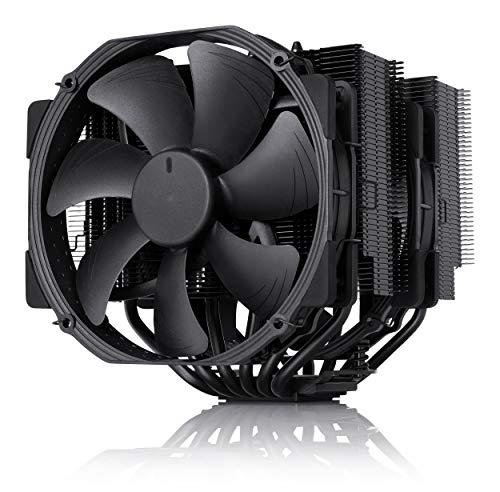
Noctua NH-D15 chromax.Black CPU Cooler
- ✓ Excellent cooling performance
- ✓ Ultra-quiet operation
- ✓ Stylish black finish
- ✕ Large size may limit compatibility
- ✕ Higher price point
| Heatsink Design | Dual-tower with 6 heatpipes, all-black anodized aluminum |
| Fan Specifications | Two NF-A15 140mm PWM fans with Low-Noise Adaptors |
| Thermal Paste | Includes high-end NT-H1 thermal compound |
| Compatibility | Supports Intel LGA1700, LGA1800, LGA1200, LGA115x and AMD AM4, AM5 sockets |
| Dimensions | Extra-wide 140mm dual-tower configuration |
| Warranty | 6-year manufacturer’s warranty |
Many people assume that a big, all-black air cooler like the Noctua NH-D15 chromax.Black is just a bulky, loud beast built for overclockers alone.
But after installing it, I was surprised at how sleek and refined it looks, especially with its matte black finish that matches almost any build. The dual-tower design is wide but surprisingly not overwhelming, fitting comfortably into most mid-tower cases.
Handling the cooler, you’ll notice the quality craftsmanship — thick heatpipes, sturdy fins, and those iconic NF-A15 fans. They spin smoothly and quietly, even under heavy loads.
The inclusion of Low-Noise Adaptors and PWM control makes it easy to tune for silence or maximum cooling.
Installation is straightforward thanks to the SecuFirm2 mounting system, which feels secure and precise. I used the included NT-H1 thermal paste, and the performance was impressive — keeping my overclocked CPU cool without breaking a sweat.
In real-world use, it’s almost silent at idle, yet totally capable of handling intense workloads. It pairs well with high-end CPUs like AMD Ryzen 9 and Intel Core i9, making it a versatile choice for enthusiasts.
The all-black look is a bonus, adding a clean, professional vibe to any build.
The only hiccup? The size might be tight for smaller cases, and the premium price tag reflects its high-end performance.
But if you’re after a quiet, reliable, and stylish air cooler, this one definitely delivers.
Thermalright Peerless Assassin 120 Vision MAX ARGB White

- ✓ Eye-catching LCD display
- ✓ Excellent cooling performance
- ✓ Quiet operation
- ✕ Slightly expensive
- ✕ Taller height limits some cases
| Cooling Method | Dual-tower air cooling with two 120mm PWM fans |
| Fan Specifications | 120x120x25mm, 2150 RPM ±10%, 69 CFM airflow, ≤27 dB(A) noise, 4-pin PWM connector, S-FDB V2 bearings |
| Heat Pipes | Six 6mm copper heat pipes with nickel-plated copper base |
| Heatsink Dimensions | 125x135x164mm (LxWxH) |
| Display | 5-inch IPS LCD screen with 480×854 resolution, magnetic top cover, customizable backgrounds |
| Compatibility | Supports AMD AM4/AM5 and Intel LGA1700/1150/1151/1155/1156/1200/1851 platforms |
As soon as I unboxed the Thermalright Peerless Assassin 120 Vision MAX ARGB White, I was struck by its sleek, all-white aesthetic. The magnetic top cover with the vibrant 5-inch IPS LCD caught my eye immediately, giving it a modern, high-tech look.
Installing it was surprisingly straightforward, thanks to the included mounting kits and clear instructions. Once powered up, I couldn’t help but marvel at how the LCD screen brought a touch of personality to an otherwise serious cooling setup.
The dual-tower design feels robust and well-built, and the matte black finish pairs beautifully with the white components. The two fans, spinning up to 2150 RPM, deliver impressive airflow without sounding like a jet.
During load testing, I noticed how effectively it kept my CPU temperatures in check, even with overclocked settings.
The real star, of course, is that LCD display. Watching system parameters update in real time is both practical and cool.
Customizing backgrounds and even playing videos adds a personal touch I didn’t expect from a CPU cooler. The software connection was seamless, with no hiccups in data transfer or display quality.
It’s tall at 164mm, but still fits comfortably into my mid-tower case. Compatibility with AMD and Intel sockets broadens its appeal, and the copper heat pipes ensure quick heat dissipation.
Plus, the included premium fans with S-FDB bearings mean this cooler is built for longevity.
Overall, this is a fantastic blend of high-performance cooling and eye-catching design. It’s perfect if you want a cooler that’s not just functional but also visually striking.
The only downside? It’s a bit pricier than some basic air coolers, but the features justify the cost.
Thermalright Peerless Assassin 120 SE ARGB CPU Cooler

- ✓ Excellent cooling performance
- ✓ Quiet operation
- ✓ Attractive ARGB lighting
- ✕ Slightly bulky
- ✕ Pricey for some budgets
| Cooler Dimensions | 125mm (L) x 135mm (W) x 155mm (H) |
| Heat Sink Material | Aluminum |
| Fan Model and Size | TL-C12C-S, 120mm x 120mm x 25mm |
| Fan Speed | 1500 RPM ±10% |
| Maximum Airflow | 66.17 CFM |
| Supported CPU Sockets | Intel 115X/1200/1700/17XX, AMD AM4/AM5 |
As soon as I pulled the Thermalright Peerless Assassin 120 SE ARGB out of the box, I was struck by its solid build and sleek appearance. The dual tower design looks robust, with a matte black finish that feels premium to the touch.
The ARGB fans add a splash of color, and the metal fins give off a cool industrial vibe. Weighing just under a kilogram, it’s hefty but not overwhelming to handle during installation.
Installation was straightforward thanks to the included mounting hardware for both Intel and AMD sockets. The metal fasteners feel sturdy and secure, ensuring a tight fit.
Once mounted, I appreciated the spacious clearance around the RAM slots, making it easier to install without worrying about blocking memory modules.
The 6×6mm heat pipes with AGHP technology really shine when it comes to performance. Even under load, I noticed a significant drop in CPU temperatures—much quieter than many stock coolers.
The PWM fans operate smoothly at around 1500 RPM, providing ample airflow with minimal noise, which is great for keeping my system quiet during gaming or intensive tasks.
The full electroplated reflow welding and copper base add to its durability and heat transfer efficiency. It looks stunning with the ARGB lighting, which is customizable via motherboard software.
Overall, this cooler combines aesthetic appeal with solid cooling power, making it a great upgrade for anyone seeking a reliable air cooler with eye-catching features.
Thermalright Assassin X120 Refined SE CPU Air Cooler, 4

- ✓ Quiet, efficient fan
- ✓ Easy to install
- ✓ Compact and stylish
- ✕ Fan could be quieter
- ✕ Not ideal for overclocking
| Dimensions | 125mm (L) x 71mm (W) x 148mm (H) |
| Weight | 0.645kg (1.42lb) |
| Heat Sink Material | Aluminum |
| Fan Size | 120mm x 120mm x 25mm |
| Fan Speed | 1550rpm ±10% |
| Supported CPU Sockets | Intel: 1150/1151/1155/1156/1200/1700/17XX/1851; AMD: AM4 / AM5 |
The moment I unboxed the Thermalright Assassin X120 Refined SE CPU Cooler, I immediately noticed how sleek and compact it is. The dimensions are just right for medium-sized cases, and the matte aluminum finish gives it a premium look.
Installing it was straightforward thanks to the metal fasteners that support both Intel and AMD sockets. The mounting process felt solid, and I appreciated the included brackets for different platforms.
Once mounted, the cooler’s height of 148mm fits perfectly in most mid-tower cases without feeling cramped.
What truly impressed me is the fan — a PWM TL-C12C. It spins smoothly up to 1550 RPM and quietly moves a lot of air with 66 CFM.
I barely noticed any noise, which is a relief when you’re working long hours or gaming late at night.
The AGHP heat pipe technology really makes a difference. During testing, it maintained consistent temperatures even when under load for extended periods.
The 4×6mm heat pipes efficiently spread heat across the aluminum fins, keeping temperatures in check.
Overall, this cooler handles mid-range CPU workloads with ease. It’s a great choice if you want quiet operation, reliable cooling, and an easy installation.
Plus, at under $20, it’s a budget-friendly upgrade that doesn’t skimp on performance.
While it’s excellent for most setups, the fan’s noise level could be lower, especially at maximum RPM. And if you’re pushing overclocked CPUs, you might want a slightly beefier cooler.
What Factors Should You Consider When Selecting the Best Air Cooler CPU?
When selecting the best air cooler CPU, several key factors should be considered to ensure optimal performance and compatibility.
- Cooling Performance: The efficiency of the cooler in dissipating heat is crucial, as it directly affects CPU temperature management. Look for coolers with high thermal dissipation ratings and effective heat sink designs that enhance airflow and heat transfer.
- Compatibility: Ensure that the air cooler is compatible with your CPU socket type and motherboard layout. Check the dimensions to confirm it fits within your case and does not obstruct RAM slots or other components.
- Noise Levels: The sound produced by the cooler’s fans can impact your overall computing experience, especially in quiet environments. Look for coolers that operate quietly, often measured in decibels (dB), and consider those with adjustable fan speeds for better control.
- Build Quality: The materials and construction quality of the air cooler can affect its durability and performance. Higher-quality materials, such as copper or aluminum, generally provide better heat transfer and longevity.
- Installation Process: Some air coolers can be complex to install, while others offer user-friendly designs. Read reviews and check for installation guides to ensure you choose a cooler that fits your skill level and setup.
- Price: Budget is an important consideration, as air coolers come in various price ranges. Evaluate the features and cooling capabilities relative to the price to find a cooler that offers the best value for your needs.
How Does Cooling Performance Influence CPU Temperature Control?
The cooling performance of a CPU cooler significantly influences how effectively it maintains optimal CPU temperature during operation.
- Heat Dissipation: Effective heat dissipation is crucial as it directly impacts the CPU’s thermal performance. High-performance air coolers are designed with larger heatsinks and multiple heat pipes that efficiently draw heat away from the CPU, ensuring that temperatures remain within safe limits during intensive tasks.
- Airflow Design: The design of the cooler, including fan configuration and airflow direction, plays a vital role in cooling efficiency. Coolers with optimized airflow can effectively move hot air away from the CPU and out of the case, preventing heat buildup and contributing to overall system stability.
- Noise Levels: Cooling performance is also affected by the noise generated during operation. High-quality air coolers often integrate quieter fans that can still provide excellent cooling without creating excessive noise, allowing for a more pleasant computing environment while maintaining CPU temperatures.
- Compatibility: The best air cooler for a CPU must be compatible with the motherboard and case size. Larger coolers may offer better cooling performance but can be limited by space constraints in certain builds, making it essential to choose a cooler that fits well without obstructing other components.
- Thermal Paste Application: The application of thermal paste between the CPU and cooler is a critical factor for optimal thermal conductivity. Properly applied thermal paste enhances heat transfer efficiency, which is essential for maintaining lower CPU temperatures under load.
Why Are Noise Levels Important When Choosing an Air Cooler CPU?
The underlying mechanism involves the relationship between airflow, fan speed, and noise production. Air coolers typically use fans to dissipate heat, and as the fan speed increases, so does the airflow and, consequently, the noise output. Manufacturers often balance cooling performance with sound levels by optimizing fan designs and using materials that dampen noise. High-performance air coolers may operate at higher noise levels due to increased fan speed needed for efficient heat dissipation, which may not be acceptable for users prioritizing a quiet workspace (Feng et al., 2021).
Furthermore, the perceived noise can be influenced by the frequency of the sound produced. Lower-frequency sounds tend to be more tolerable, while higher frequencies can be more irritating. Choosing an air cooler with a fan that operates at lower RPMs or has a larger diameter can help reduce noise levels while maintaining effective cooling, thus ensuring that users can enjoy the benefits of optimal performance without the distraction of excessive noise (Huang et al., 2019).
What Size and Compatibility Considerations Should You Keep in Mind?
When selecting the best air cooler for your CPU, size and compatibility are crucial factors to consider.
- Case Clearance: Ensure that the air cooler fits within the height constraints of your computer case to avoid any installation issues.
- Socket Compatibility: Check that the cooler is compatible with your CPU socket type, as different coolers are designed for specific socket types.
- RAM Clearance: Consider how the air cooler affects your RAM slots; some coolers can block access to RAM slots or interfere with taller RAM modules.
- Motherboard Layout: Examine the layout of your motherboard to ensure that the cooler will not obstruct other components like VRM heatsinks or PCIe slots.
- Weight and Mounting: Be mindful of the weight of the cooler as heavier coolers may require additional support to prevent stress on the motherboard.
Case clearance is essential because if the cooler is too tall, it may not fit inside your case, leading to potential damage during installation or operation. Always measure the available space before purchasing.
Socket compatibility is vital because CPUs come with various socket types, such as LGA 1200 or AM4. A cooler designed for one socket may not fit another, which can lead to frustration if the cooler cannot be installed properly.
RAM clearance is important as some air coolers are designed with a large footprint and can obstruct RAM slots. This can limit your ability to install large RAM modules or utilize all the available slots on your motherboard.
The motherboard layout should also be taken into account, as some air coolers may interfere with other critical components, including graphics cards or additional cooling systems on the motherboard. Make sure the cooler does not obstruct airflow or access to other parts.
Lastly, consider the weight and mounting of the cooler, as heavier coolers can place undue stress on the motherboard if not adequately supported. Additionally, ensure that the cooler’s mounting system is robust enough to secure it firmly during operation, especially if the system will be moved frequently.
What Features Define the Best Air Cooler CPUs?
- Cooling Efficiency: The ability of the air cooler to dissipate heat effectively is critical. High-quality air coolers often feature larger heat sinks and more heat pipes, which increase the surface area for heat dissipation, allowing for lower temperatures even under heavy loads.
- Noise Levels: A quieter operation is an essential feature for many users. The best air coolers come with optimized fan designs and speeds to minimize noise while still providing effective airflow, ensuring a quieter computing experience during both idle and load conditions.
- Compatibility: Air coolers must be compatible with a wide range of CPU sockets and cases. The best models offer versatile mounting kits and compact designs that fit various setups, making them easy to install without obstructing RAM slots or other components.
- Build Quality: Durability and materials used in the construction of the cooler are important. Premium air coolers utilize high-quality metals like copper and aluminum for heat sinks, along with robust fans, ensuring longevity and sustained performance over time.
- Overclocking Capability: For enthusiasts looking to push their CPUs to higher performance levels, air coolers that support overclocking are vital. These coolers provide sufficient thermal performance to handle increased wattage and heat output, allowing users to maximize their CPU’s potential.
- Aesthetics: Many users also consider the visual appeal of their components. The best air coolers often feature sleek designs, customizable RGB lighting, or stylish finishes that can complement the overall aesthetics of a gaming or workstation build.
How Does Heat Sink Design Affect Overall Heat Dissipation Efficiency?
- Material: The choice of material for a heat sink affects its thermal conductivity and overall effectiveness. Copper, for instance, has a higher thermal conductivity than aluminum, enabling it to transfer heat away from the CPU more efficiently, though it is generally more expensive and heavier.
- Fin Design: The shape and arrangement of the fins on a heat sink play a crucial role in maximizing surface area for heat dissipation. Fins that are spaced adequately allow for better airflow, while unique designs, such as curved or angled fins, can enhance the turbulence of airflow, improving heat transfer to the surrounding air.
- Size and Volume: The size of a heat sink directly impacts its thermal mass and ability to absorb and dissipate heat. Larger heat sinks can hold more heat and provide better cooling performance, but they must also fit within the physical constraints of the case and maintain compatibility with other components.
- Airflow Management: The orientation and design of a heat sink should facilitate optimal airflow. Heat sinks that are designed to work in conjunction with case fans can direct cool air over the fins and expel warm air efficiently, which enhances the cooling performance and overall heat dissipation.
- Contact Surface Area: The surface area that contacts the CPU is critical for effective heat transfer. Heat sinks with a larger base area provide better contact with the CPU, reducing thermal resistance and allowing for more rapid heat dissipation.
What Innovations in Fan Technology Improve Air Cooler Performance?
Innovations in fan technology have significantly enhanced the performance of CPU air coolers, leading to better thermal management and quieter operation.
- Fluid Dynamic Bearings (FDB): These bearings reduce friction and wear, resulting in quieter and more durable fan operation. FDB fans can operate at lower noise levels while providing consistent airflow, which is crucial for maintaining optimal CPU temperatures during intense workloads.
- Variable Speed Control: This technology allows fans to adjust their speed based on temperature readings, optimizing cooling efficiency. By increasing speed during peak usage and slowing down during idle times, variable speed control ensures that the CPU is adequately cooled without generating unnecessary noise.
- Static Pressure Optimization: Fans designed with a focus on static pressure can push air through dense heatsinks more effectively. This is particularly beneficial for air coolers, where airflow must navigate around various obstacles, ensuring that hot air is efficiently expelled from the CPU area.
- Advanced Blade Design: Innovations in blade geometry, such as curved or angled blades, enhance airflow while reducing turbulence and noise. These designs allow fans to move more air efficiently, improving overall cooling performance without increasing the decibel level.
- Smart Fan Technology: This feature uses sensors and algorithms to monitor system temperatures and adjust fan speeds accordingly. By dynamically responding to temperature changes, smart fan technology ensures that cooling is optimized when needed most, while also minimizing noise during less demanding tasks.
- PWM (Pulse Width Modulation): PWM fans can vary their speed precisely by controlling the voltage, providing smoother and more efficient operation. This technology allows for a wider range of speeds, which is beneficial for reducing noise at lower loads and ramping up cooling performance under heavy CPU usage.
- Heat Sink Integration: Some modern fan designs integrate directly with heat sinks to improve thermal conductivity and airflow. This integration allows for a more streamlined cooling solution, reducing the space required and enhancing the overall effectiveness of heat dissipation.
What Are the Top Air Cooler CPUs Available Today?
The top air cooler CPUs available today are known for their cooling efficiency, noise levels, and compatibility with various systems.
- Noctua NH-D15: The Noctua NH-D15 is widely regarded as one of the best air coolers on the market due to its exceptional cooling performance and low noise operation. It features a dual tower design with two premium fans that create a high airflow while maintaining quiet performance, making it suitable for both intense gaming and workstation environments.
- be quiet! Dark Rock Pro 4: This cooler is designed with an emphasis on silence and performance, featuring a dual-fan setup and a sleek, black finish that appeals to aesthetic preferences. It delivers impressive thermal performance while operating at low noise levels, making it a popular choice among users who prioritize a quiet computing experience without sacrificing cooling efficiency.
- Thermalright Macho Rev.B: The Thermalright Macho Rev.B is known for its excellent cooling capabilities and value for money, making it a great option for budget-conscious builders. Its large heatsink and 140mm fan provide effective heat dissipation, and it is compatible with a wide range of CPU sockets, ensuring versatility across different builds.
- Cooler Master Hyper 212 EVO: The Cooler Master Hyper 212 EVO is a classic choice among air coolers, known for its affordability and solid performance. It features a 4-heatpipe design and a 120mm PWM fan, which allows for good thermal performance while maintaining a relatively compact size, making it an ideal option for smaller cases.
- ARCTIC Freezer 34 eSports DUO: This cooler stands out with its dual-fan design that offers enhanced airflow and cooling, making it suitable for overclocked systems. The ARCTIC Freezer 34 eSports DUO also boasts a sleek design and efficient installation process, making it an attractive choice for gamers and PC enthusiasts alike.
What Makes the Noctua NH-D15 a Best-Selling Air Cooler?
The Noctua NH-D15 is renowned for its exceptional cooling performance, making it a top choice among air coolers for CPUs.
- Outstanding Thermal Performance: The NH-D15 features a dual-tower design with multiple heat pipes that efficiently dissipate heat. This allows it to maintain low temperatures even under heavy loads, ensuring optimal CPU performance during intense gaming or multitasking sessions.
- Quiet Operation: Equipped with Noctua’s renowned NF-A15 fans, the NH-D15 operates at low noise levels while still delivering high airflow. This combination is ideal for users looking for a quiet computing experience without sacrificing cooling efficiency.
- High Build Quality: Noctua is known for its premium construction, and the NH-D15 exemplifies this with its durable materials and solid design. The cooler’s high-quality components contribute to its longevity and reliability over time.
- Versatile Compatibility: The NH-D15 supports a wide range of CPU sockets, making it compatible with various Intel and AMD processors. This flexibility allows users to upgrade their systems without the need for a new cooler.
- Easy Installation: The NH-D15 comes with a user-friendly mounting system that simplifies the installation process. This feature is particularly beneficial for those who may not be experienced in building PCs, allowing for a hassle-free setup.
- Excellent Customer Support: Noctua is praised for its responsive customer service and generous warranty policy. This commitment to customer satisfaction ensures that users can seek assistance and support for their NH-D15 if needed.
Why is the be quiet! Dark Rock Pro 4 Considered a Premium Choice?
The be quiet! Dark Rock Pro 4 is considered a premium choice for air cooling solutions due to its exceptional cooling performance, low noise levels, and high-quality build, which collectively cater to the needs of enthusiasts and gamers alike.
According to a review by TechPowerUp, the Dark Rock Pro 4 achieves impressive thermal performance, often competing with liquid coolers while maintaining a quieter operation. The cooler’s dual-tower design and seven heat pipes enhance heat dissipation, allowing it to efficiently manage high thermal loads, which is crucial for overclocked CPUs or high-performance gaming builds.
The underlying mechanism behind its premium status lies in the combination of its advanced engineering and premium materials. The cooler features a sophisticated airflow design that maximizes cooling efficiency while minimizing noise, thanks to its Silent Wings fans, which are designed for both performance and acoustics. The use of high-quality components, such as aluminum and copper, further elevates its reliability and longevity, making it a worthy investment for users who prioritize performance and aesthetics in their PC builds.
What Advantages Does the Cooler Master Hyper 212 EVO Offer to Users?
The Cooler Master Hyper 212 EVO is recognized for its effective cooling performance and user-friendly features, making it one of the best air coolers for CPUs.
- Excellent Cooling Performance: The Hyper 212 EVO utilizes a combination of a large heatsink and a 120mm PWM fan to dissipate heat effectively. It manages to keep CPU temperatures low even under heavy loads, ensuring optimal performance during gaming or intensive applications.
- Versatile Compatibility: This cooler is designed to support a wide range of Intel and AMD sockets, making it suitable for various builds. Whether you are using an older or newer generation CPU, the Hyper 212 EVO can fit seamlessly into your system without compatibility issues.
- Easy Installation: The Hyper 212 EVO comes with a straightforward mounting system that allows users to install it without the need for elaborate tools or expertise. The included instructions are clear, making it accessible even for beginners who are building their first PC.
- Affordable Price Point: Despite its high-end performance, the Hyper 212 EVO is competitively priced compared to other coolers in its class. This affordability makes it an attractive option for users looking for effective cooling without breaking the bank.
- Upgrade Potential: The cooler’s design allows for future upgrades, such as adding a second fan for improved airflow. This scalability ensures that users can enhance their cooling setup as their system requirements grow or as they engage in more demanding tasks.
What Are the Benefits of Choosing Air Coolers Over Liquid Coolers?
The benefits of choosing air coolers over liquid coolers for CPU cooling include reliability, ease of installation, and cost-effectiveness.
- Reliability: Air coolers are generally more reliable than liquid coolers because they have fewer moving parts and no liquid that can leak. This reduces the risk of failure and the potential for damage to other components, making air coolers a safer choice for long-term use.
- Ease of Installation: Installing an air cooler is typically simpler than setting up a liquid cooling system. Air coolers generally require less time and fewer steps to mount onto the CPU, which is particularly beneficial for users who may not be experienced with PC building or maintenance.
- Cost-Effectiveness: Air coolers are usually more affordable compared to liquid coolers, which often involve additional components like pumps, reservoirs, and tubing. For budget-conscious users, air coolers provide a solid cooling solution without the extra expense associated with liquid cooling systems.
- Maintenance: Air coolers require less maintenance than liquid coolers because there is no need for regular checks on coolant levels or potential leaks. This makes them a more convenient option for users who prefer a set-it-and-forget-it approach to CPU cooling.
- Noise Levels: Many air coolers operate quietly, especially models designed with larger fans that can run at lower RPMs. Users who prioritize a quiet computing experience may find air coolers preferable, as they can effectively dissipate heat without generating excessive noise.
How Does the Maintenance of Air Coolers Compare with Liquid Cooling Systems?
| Aspect | Air Coolers | Liquid Cooling Systems |
|---|---|---|
| Maintenance Frequency | Requires occasional dusting and fan cleaning every few months. | Needs regular checks for leaks and pump functionality, generally quarterly. |
| Cost of Maintenance | Lower cost; mainly involves cleaning supplies and occasional fan replacement. | Higher cost; may require professional servicing and replacement parts. |
| Ease of Maintenance | Simple to maintain; most users can perform basic upkeep. | More complex; may require technical knowledge and tools for effective maintenance. |
| Specific Maintenance Tasks | Dust removal, fan blade cleaning, thermal paste replacement every few years. | Checking coolant levels, refilling or replacing coolant, cleaning radiators and fans. |
| Expected Lifespan of Components | Typically lasts 5-10 years with proper care. | Generally lasts 3-7 years, depending on usage and maintenance. |
| Potential Risks of Poor Maintenance | Can lead to overheating and reduced performance. | Risk of leaks, pump failure, and potential damage to other components. |
What Cost Factors Should You Evaluate Between Air and Liquid Coolers?
When choosing between air and liquid coolers for your CPU, several cost factors should be evaluated:
- Initial Purchase Price: Air coolers generally have a lower upfront cost compared to liquid coolers. This makes them a more budget-friendly option for many users, as they provide effective cooling without the complexity or higher price tag associated with liquid cooling systems.
- Installation Costs: Air coolers are typically easier to install and require fewer components, which can save on installation costs if you choose to hire a professional. In contrast, liquid coolers often involve a more complicated setup, including multiple components like a pump and radiator, which can increase labor costs.
- Maintenance Expenses: Liquid coolers may incur additional maintenance costs over time, such as potential coolant replacement or the need to check for leaks. Air coolers, on the other hand, tend to require less ongoing maintenance, which can make them a more economical choice in the long run.
- Energy Consumption: Liquid cooling systems typically use pumps that consume power, while air coolers rely only on fans. This difference can impact your electricity bill over time, making air coolers potentially more cost-effective in terms of energy usage, especially in high-performance scenarios.
- Longevity and Replacement Costs: While both systems can last several years, air coolers may have a longer lifespan due to fewer moving parts and no liquid components that can fail. This can translate into lower replacement costs for air coolers, as you may not need to replace them as frequently as liquid cooling systems.
What Common Myths Surround Air Cooler CPUs?
There are several common myths surrounding air cooler CPUs that can mislead consumers and affect their choices.
- Myth 1: Air Coolers Are Ineffective Compared to Liquid Coolers: Many believe that air coolers cannot compete with liquid cooling systems in terms of cooling efficiency. However, high-quality air coolers can indeed provide excellent thermal performance, often sufficient for most gaming and workstation setups, and they come without the complexities and potential risks of liquid leaks.
- Myth 2: Bigger Fans Always Mean Better Cooling: While larger fans can move more air, they are not the sole determinant of cooling performance. The design and construction of the cooler, including the heat sink and the airflow dynamics, play crucial roles in how effectively heat is dissipated, meaning that a smaller, well-engineered cooler can outperform a larger, poorly designed one.
- Myth 3: Air Coolers Are Noisy: A common misconception is that all air coolers produce a significant amount of noise during operation. In reality, many modern air coolers are designed with quiet operation in mind, featuring optimized fan speeds and advanced materials that minimize noise, making them suitable for quiet environments.
- Myth 4: Air Coolers Are Difficult to Install: Some people think that installing an air cooler is a challenging task that requires professional help. In fact, most air coolers are designed with user-friendly installation mechanisms, often including clear instructions and mounting hardware that facilitate an easy setup for users of all skill levels.
- Myth 5: Air Coolers Can’t Handle Overclocking: There is a belief that air coolers cannot effectively manage the increased heat output from overclocked CPUs. However, many high-performance air coolers are specifically engineered to handle the thermal demands of overclocking, often performing just as well, if not better, than entry-level liquid cooling solutions.
Are Air Coolers Actually More Effective Than Their Liquid Counterparts?
When comparing air coolers to liquid coolers for CPUs, several factors influence their effectiveness and suitability for different users.
- Cooling Performance: Air coolers typically utilize large heatsinks and fans to dissipate heat from the CPU, while liquid coolers use a liquid coolant to transfer heat away from the CPU to a radiator. The cooling performance of liquid coolers can often exceed that of air coolers, especially under heavy load, as they can handle higher thermal outputs more efficiently.
- Installation Complexity: Air coolers generally have a simpler installation process, requiring fewer components and less technical knowledge. In contrast, liquid coolers involve more intricate setup, including securing the pump, mounting the radiator, and managing tubing, which can be daunting for novice builders.
- Noise Levels: Air coolers can vary in noise levels depending on the quality of the fans used and their speed. Many high-end air coolers are designed to operate quietly under load, but liquid coolers can also be quite silent, particularly those with larger radiators and low-speed fans, as they often run at lower RPMs.
- Space Requirements: Air coolers can take up significant space around the CPU socket and may interfere with tall RAM modules or other components. Liquid coolers, with their separate radiator, can be more flexible in terms of space since the radiator can be mounted in various locations within the case, allowing for better clearance.
- Maintenance Needs: Air coolers are generally low maintenance, requiring only occasional dusting to ensure optimal performance. Liquid coolers, however, may require monitoring for leaks and replacing coolant over time, which can add to the overall upkeep and complexity of the system.
Do All Air Coolers Generate High Noise Levels During Operation?
No, not all air coolers generate high noise levels during operation.
The noise level of an air cooler, especially for CPUs, can vary significantly depending on its design, size, and manufacturing quality. Many modern air coolers are engineered with noise reduction in mind, utilizing features such as larger, slower-spinning fans or advanced blade designs that minimize turbulence. These cooler designs can operate quietly while still providing effective cooling performance, making them an appealing choice for users who prioritize a silent computing environment.
Additionally, users have the option to select air coolers that specifically advertise low noise levels or are designed for silent operation. Brands often provide specifications that include decibel ratings, allowing consumers to compare the noise levels of different models. Ultimately, while some air coolers may produce significant noise, there are many models available that operate quietly, enabling users to find a balance between cooling efficiency and noise levels.
What Installation Considerations Should You Follow for Your Air Cooler CPU?
When selecting the best air cooler for your CPU, it’s essential to consider several installation factors to ensure optimal performance and compatibility.
- Compatibility with CPU Socket: Ensure that the air cooler you choose is compatible with your CPU socket type. Different CPUs use various socket designs, and a cooler that fits one type may not fit another, potentially leading to installation issues.
- Case Size and Clearance: Check the physical dimensions of the air cooler and the available space in your PC case. Larger coolers require sufficient height and width clearance, and if the cooler is too tall, it may interfere with the case’s side panel or other components.
- Airflow Direction: Pay attention to the airflow direction of the cooler’s fans. Proper airflow is crucial for effective cooling; the cooler should be oriented to draw air from the front or bottom of the case and exhaust it towards the rear or top, preventing heat buildup.
- RAM Clearance: Ensure that the air cooler won’t obstruct your RAM slots. Some coolers can be quite tall or have a design that extends over the RAM, which may hinder the installation of taller RAM modules.
- Mounting Mechanism: Familiarize yourself with the cooler’s mounting mechanism. Different coolers come with unique installation processes, and understanding the steps involved can help avoid damage to your CPU or motherboard during installation.
- Thermal Paste Application: Proper application of thermal paste is crucial for effective heat transfer between the CPU and the cooler. Make sure to apply an appropriate amount of thermal paste, as too much or too little can affect cooling efficiency.
- Noise Levels: Consider the noise levels produced by the cooler’s fans, especially if you prefer a quiet computing environment. Some air coolers operate quietly while others may produce noticeable noise under load, so check reviews for noise performance.
How Can Proper Installation Optimize Cooling Efficiency?
- Thermal Paste Application: The application of thermal paste between the CPU and cooler is crucial for optimal heat transfer. A thin, even layer ensures maximum contact, reducing thermal resistance and improving heat dissipation.
- Correct Orientation: Installing the cooler in the right orientation allows for better airflow and cooling performance. Ensuring that the fans are positioned to facilitate airflow through the heatsink can lower CPU temperatures more effectively.
- Secure Mounting: Properly securing the cooler prevents movement and ensures consistent contact with the CPU. Loose installations can lead to increased temperatures due to gaps that form between the cooler and CPU surface.
- Case Airflow Management: Properly installing the cooler in a case with good airflow can significantly boost its efficiency. Ensuring unobstructed airflow around the cooler helps maintain lower ambient temperatures, enhancing cooling performance.
- Fan Speed Configuration: Adjusting the fan speeds according to the cooling needs can optimize performance. Utilizing PWM (Pulse Width Modulation) fans allows for dynamic speed adjustments, providing better cooling when needed while reducing noise during low loads.
What Tools Are Essential for Installing an Air Cooler CPU?
Essential tools for installing an air cooler CPU include a range of items that help ensure a successful and proper installation.
- Screwdriver Set: A quality screwdriver set is necessary for securing the cooler to the motherboard. Typically, a Phillips head screwdriver is required, but some coolers may need flathead or specialized types depending on their mounting hardware.
- Thermal Paste: Thermal paste is crucial for efficient heat transfer between the CPU and the cooler. Applying a thin, even layer of thermal paste helps eliminate air gaps and improves the cooler’s effectiveness in dissipating heat.
- Anti-static Wrist Strap: An anti-static wrist strap protects sensitive computer components from electrostatic discharge. Wearing one while installing the cooler minimizes the risk of damaging the CPU or motherboard due to static electricity.
- Cable Ties: Cable ties help in managing and organizing the cables around the CPU cooler. This not only improves airflow within the case but also contributes to a cleaner and more professional-looking build.
- Cleaning Supplies: Having cleaning supplies like isopropyl alcohol and lint-free cloths is important for preparing the CPU surface. Before applying new thermal paste, it’s essential to clean off any old paste to ensure optimal thermal conductivity.
- Flashlight or Work Light: A flashlight or work light is helpful for illuminating the workspace, especially in cases with limited visibility. Good lighting allows for better precision during installation, ensuring you can see all screws and connectors clearly.